What is Colorado tick fever? A viral fever from Rocky Mountain wood ticks in the western mountains.
Colorado tick fever is uncommon and usually mild, though weakness can last for weeks. No medicine treats it, so preventing wood tick bites in spring and early summer is the main defense.
Colorado tick fever is a viral illness spread by the bite of an infected Rocky Mountain wood tick, found in the western US and western Canada at about 4,000 to 10,000 feet (1,219 to 3,048 m). Most cases begin in spring and early summer, and about half of patients have a fever that fades and then returns. There is no specific medicine for it; most people recover completely, though tiredness can linger for weeks. After an infection, CDC says not to donate blood or bone marrow for 6 months.
What Colorado tick fever is
Colorado tick fever is a rare disease caused by Colorado tick fever virus, a coltivirus in the reovirus family. Despite the name, it occurs across the western United States and western Canada, at about 4,000 to 10,000 feet (1,219 to 3,048 m) above sea level. In Colorado, CSU Extension calls it by far the most common disease spread by ticks.
The virus circulates between ticks and small rodents such as squirrels, chipmunks and mice, its most important reservoirs. Ticks pick up the virus by feeding on an infected rodent and pass it to other animals, or to people, when they feed again.
It does not spread from person to person, with rare exceptions: one case each of spread by blood transfusion and from mother to baby around birth has been documented. Because the virus can stay in red blood cells for months, CDC says people should not donate blood or bone marrow for 6 months after infection.
The tick that spreads it
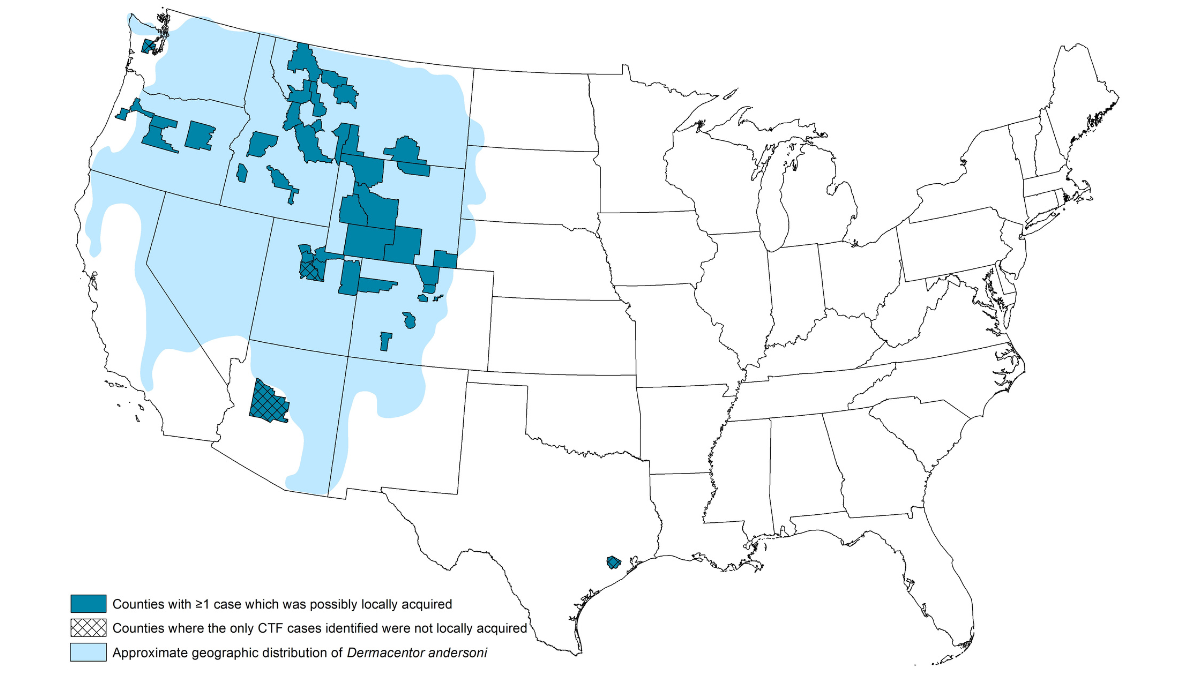
The carrier is the Rocky Mountain wood tick (Dermacentor andersoni). CDC places it in the Rocky Mountain states and southwestern Canada, and adult ticks are the stage mainly linked to spreading disease to people. The same tick can also carry Rocky Mountain spotted fever and tularemia.
Wood ticks are most active in spring and early summer, and a CDC report describes their habitat as grassy areas near sagebrush. In a 2018 cluster in central Oregon, all four confirmed patients spent at least 5 hours a day outdoors, including work in wooded or brushy areas, and all reported a tick bite in the 2 weeks before they got sick.
Where and when it occurs
Colorado tick fever is not a nationally notifiable disease, so national counts are incomplete. CDC received reports of 223 cases from 2003 through 2022, a median of 7 a year (range 3 to 37). As of 2023 it was reportable in ten states: Arizona, Colorado, Idaho, Montana, New Mexico, Oregon, South Dakota, Utah, Washington and Wyoming.
CDC does not publish yearly counts by state. Its map of 2013-2022 cases shows most patients living in Montana, Wyoming, Idaho, Utah, Colorado, Oregon and Washington. A CDC review of 2002-2012 found the highest rates among residents of Wyoming (3.4 cases per million people a year), Montana (1.5) and Utah (0.5), with all infections in that period acquired in six western states.
State health departments report small numbers. Wyoming typically sees about two cases a year (2020), Montana about four on average, Utah one or two (2024 report), and Oregon a median of one a year in 2009-2025.
Most cases start in spring or early summer, when wood ticks are most active: 80% of cases in 2002-2012 began in May through July. Residents and visitors both get it, and the share of cases among travelers from other states grew over that decade.
Symptoms and when to see a doctor
Symptoms begin about 1 to 14 days after the tick bite. The most common are fever, chills, headache, body aches and feeling tired, and some people also have a sore throat, vomiting, belly pain or a skin rash.
About half of patients have a biphasic fever: several days of fever, a few days of feeling better, then a second short bout of fever and illness. Most people have mild illness and recover completely, though weakness and fatigue can last several weeks, especially in adults over 30. A CDC report says up to 30% of patients need a hospital stay, and death is rare.
Rarely, the virus affects the central nervous system, and CDC lists a stiff neck and confusion among the signs of this severe form; get care right away for those. See a doctor for any fever after time in wood tick country and say where you hiked or worked, since early symptoms look like other tickborne illnesses, including Rocky Mountain spotted fever, which needs prompt treatment.
Diagnosis and treatment
Doctors base an early diagnosis on symptoms, places and dates of travel, outdoor activities and possible tick exposure, then confirm it with blood tests. Early in the illness a PCR test for the virus is the most sensitive, because antibodies may not show up until 14 to 21 days after symptoms start. Low white blood cell and platelet counts are common clues.
No medicine treats Colorado tick fever, and antibiotics do not work against viruses. Rest, fluids and over-the-counter pain relievers may ease symptoms, and people with severe illness may need a hospital stay for intravenous fluids and medicine for pain and fever. Because the illness can look like Rocky Mountain spotted fever, CDC's guide for clinicians says to follow spotted fever treatment guidance when that disease is suspected, so a doctor may still prescribe an antibiotic while test results are pending.
Prevention and blood donation
There is no vaccine or medicine to prevent Colorado tick fever, so avoiding wood tick bites is the main defense, especially on spring and early summer outings in the mountains. CDC recommends:
In the 2018 Oregon cluster, all four patients wore long sleeves and pants outdoors, but none used insect repellent. Anyone who has had Colorado tick fever should wait 6 months before donating blood or bone marrow.
- An EPA-registered insect repellent, or repellent-treated clothing
- Long sleeves and long pants
- Avoiding bushy and wooded areas with high grass where you can
- A thorough tick check after time outdoors, removing any tick quickly
Where our briefings flag it
State briefings that cover it: Colorado, Montana, New Mexico, Oregon, Utah, Wyoming.
Holiday briefings: Black Hills (Custer State Park and Wind Cave), Boulder & the Front Range Foothills, Glacier National Park, Grand Teton National Park & Jackson Hole, Rocky Mountain National Park, Sangre de Cristo Mountains (Santa Fe, Taos, Angel Fire), Yellowstone National Park.
Every state, with its ticks, season and holiday spots: ticks by state. CDC's Lyme numbers state by state: the Tick Risk Map.
Protection that works against it
There is no vaccine for it in the US, so preventing tick bites is the protection. Treated clothes, repellent on skin and a nightly check:
before you go
Permethrin spray →How to apply it
every outdoor day
Our top-scored picaridin →All the test results
If a tick bites
Take it off right away with fine-tipped tweezers, close to the skin and straight up. Note the date and where you were, keep the tick in a sealed bag or photo it, and read the 30-day timeline for what to watch and when to call a doctor.
Fever, rash, aches or unusual tiredness in the weeks after a tick bite need a doctor visit. Say that you were bitten, and where.
Questions about Colorado tick fever
Is Colorado tick fever only found in Colorado?
No. It occurs across the western United States and western Canada wherever the Rocky Mountain wood tick lives, mostly at about 4,000 to 10,000 feet (1,219 to 3,048 m). In 2002-2012, residents of Wyoming, Montana and Utah had the highest rates, and CDC's 2013-2022 case map also shows cases in Idaho, Colorado, Oregon and Washington.
Is there a treatment for Colorado tick fever?
There is no specific medicine, and antibiotics do not work against the virus. Care focuses on rest, fluids and relief of fever and pain, with a hospital stay for severe illness. Most people recover completely, although weakness and fatigue can last several weeks.
Can Colorado tick fever come back after you feel better?
Yes. About half of patients have a biphasic illness: several days of fever, a few days of feeling better, then a second, shorter bout. Doctors use this pattern, along with low white blood cell counts and where you were bitten, to tell it apart from other tickborne illnesses.
Can I donate blood after Colorado tick fever?
Not right away. CDC says people with Colorado tick fever should not donate blood or bone marrow for 6 months after their illness, because the virus can stay in red blood cells for months. Spread by blood transfusion is rare but has been documented.
When is Colorado tick fever season?
Spring and early summer, when Rocky Mountain wood ticks are most active. In a CDC review of 2002-2012 cases, 80% began in May through July.
Sources (17)
- cdc.gov/colorado-tick-fever/about/index.html
- cdc.gov/colorado-tick-fever/causes-and-spread/index.html
- cdc.gov/colorado-tick-fever/signs-symptoms/index.html
- cdc.gov/colorado-tick-fever/prevention/index.html
- cdc.gov/colorado-tick-fever/data-maps/index.html
- cdc.gov/colorado-tick-fever/media/images/CTFMapV31200x675.png
- cdc.gov/colorado-tick-fever/hcp/clinical-diagnosis/index.html
- cdc.gov/colorado-tick-fever/hcp/treatment-prevention/index.html
- cdc.gov/colorado-tick-fever/media/pdfs/ADBTickFeverpocketguideP.pdf
- cdc.gov/mmwr/volumes/68/wr/mm6812a4.htm
- stacks.cdc.gov/view/cdc/83573
- cdc.gov/ticks/about/where-ticks-live.html
- extension.colostate.edu/resource/colorado-ticks-and-tick-borne-diseases
- health.wyo.gov/colorado-tick-fever-cases-higher-than-expected
- dphhs.mt.gov/publichealth/cdepi/diseases/ticks
- epi.utah.gov/wp-content/uploads/Tick-Surveillance-Annual-Report_2024.pdf
- oregon.gov/oha/PH/DISEASESCONDITIONS/COMMUNICABLEDISEASE/Documents/CTFStatistics.pdf